What to Do When Your Airbnb Calendar Is Empty
An empty Airbnb calendar turns into constant checking. One weekly look, instead of changing the price, title, and photos in the same night.

You say you are just checking the app. Ten minutes later, you are stalking competitor calendars like a private investigator with a mortgage. You know the one three streets over — the one with the worse kitchen and the suspiciously booked June — and you've developed theories about it. You've zoomed in on their photos looking for the trick. Sometimes the trick is only light, and better listing photos on your own place are the version of it you can do tonight. You've read their reviews the way people read a rival's diary. At some point tonight you will check your own calendar again, and it will say what it said forty minutes ago, and you will feel the exact same small drop in your chest, as if the news were new. Airbnb's guide to managing your calendar and the help page on updating your host calendar are the boring controls under that spiral, and how search results work is why a neighbour's thumbnail can outrank a better kitchen.
Let's be honest about the sequence, because nobody ever describes it out loud. It starts small: one check before bed, the way you'd check the weather. Then one before coffee. Then the calendar itself, just to confirm what you already know — the next nineteen days are empty. By day three you're not checking to find out if something changed. You're checking because not checking feels like abandoning a post. You are standing guard over a silence, and the silence does not care that you're watching it.
The embarrassing part — the part you would not say at a dinner party — is that you've started narrating it. Maybe this weekend. Maybe after the holiday. Maybe the algorithm is testing me. The app has become a slot machine that only pays out in relief, and an empty calendar isn't just empty anymore. Every open night has started sounding like a bill.
This is the spiral, and almost every host who's had a slow stretch knows it from the inside. It's not really about the calendar. It's about what the calendar seems to be telling you — and the good news, the reason to keep reading instead of opening the app again, is that the spiral has a mechanism, the mechanism has an off switch, and neither one is "just stop checking."
How Checking Turns Into a Verdict
The mechanism is almost always the same. You open the app to check bookings. While you're in there, you notice a competitor's listing that popped up higher in search than yours. You open it. It looks fine, not spectacular, and that stings more than if it had been obviously better — if theirs was booked and worse, something must be wrong with yours specifically. So you go back to your own listing and start looking for the flaw. You tweak the title. You nudge the price down four dollars. You add an exclamation point to your description and immediately feel silly about it.
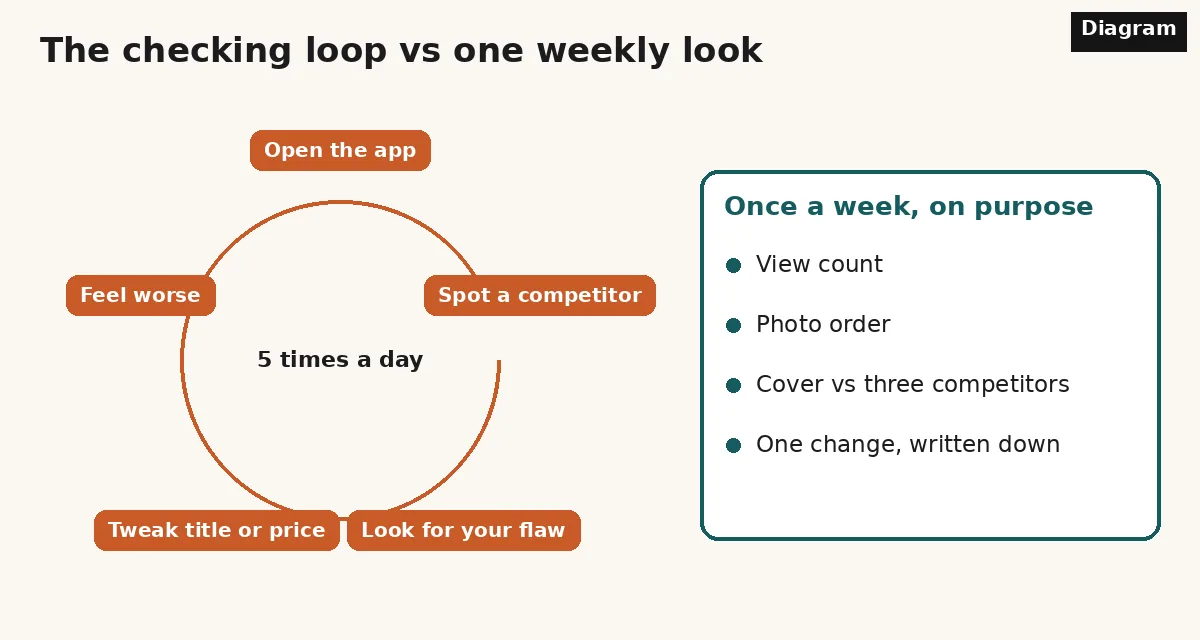
None of these changes are based on evidence. They're based on the anxious energy of having checked one too many times and needing to have done something with what you found.
The Pull That Makes This Different From Ordinary Worry
There's a reason this particular habit is so hard to talk yourself out of, and it isn't a lack of discipline. A booking notification is a small, unpredictable reward — you don't know when it's coming, and that uncertainty is exactly the pattern that keeps people checking slot machines, group chats, and inboxes far more often than any of those things deserve. An empty calendar isn't neutral in this loop. It's the absence of the reward, which the brain treats as a reason to check again sooner, not a reason to stop, because maybe this time will be different.
Layer a second host's listing on top of that, and the loop gets sharper. Comparing your own quiet calendar to someone else's, in real time, on your phone, at 11pm, is not information gathering. It's giving your anxiety a fresh data point to work with every single time, usually without the context to actually interpret what you're seeing — you don't know their booking window, their pricing history, or whether their calendar is even accurate.
Why the Loop Feels Productive When It Isn't
Checking feels like vigilance. It has the texture of responsibility — a good host stays on top of things, watches the market, responds fast. But there's a difference between monitoring a business and compulsively refreshing a source of bad news, and the empty-calendar spiral blurs that line until they feel identical. The tell is simple: are you learning something new each time you check, or are you just confirming the same absence and letting it re-sting?
Most of the time, after the first check of the day, you already have the information. Everything after that is not data collection. It's rumination wearing a host's hat.
What The Silence Is Actually Measuring
It helps to remember what an empty stretch on the calendar is and isn't measuring. It's measuring bookings in a window. It is not measuring your worth as a host, the long-term viability of the property, or how guests who did stay actually felt about it. Those get folded together under stress, until eighteen empty days start to feel like a referendum on everything at once, when really it's one number, in one window, that hasn't updated yet.
What Actually Breaks the Cycle
The way out isn't willpower — telling yourself to check less rarely survives the first anxious evening. It's replacing the checking with a scheduled, structured version of the same instinct. Instead of five reflexive glances a day that leave you either relieved or spiraling, one deliberate weekly review where you actually look at something useful: your view count, your photo order, how your cover image compares to three competitors. That's the same energy, redirected into something that can actually change the outcome. It's also the argument at the center of Your Airbnb Is Better Than Your Bookings Suggest — that a quiet calendar is usually a solvable presentation problem, not a verdict on the property, and it deserves a calm weekly look rather than five panicked ones a day.
A Smaller, Saner Routine
Replace the compulsive check with this instead
- Pick one set time each week to review the listing — same day, same hour, calendar reminder if that helps.
- Turn off non-essential notifications so a quiet phone doesn't read as a quiet calendar.
- During the weekly review, look at one specific thing — cover photo, photo order, or price — not everything at once.
- Write down the one change you're making that week before you make it, so it's a decision and not a reflex.
- Give any change two weeks to show results before checking again outside your scheduled time.
- Notice when you're opening the app out of habit rather than need, and treat that noticing as useful information about your own stress, not laziness.
It also helps to name, out loud or on paper, what you're actually afraid the empty calendar means. Most of the time it isn't "nobody wants to stay here" — it's something closer to "I made the wrong decision and I'm going to find out too late." That fear doesn't get smaller by checking five more times. It gets smaller by having one real answer to work with, which is usually what a calm weekly review is actually for: not reassurance, but information specific enough to act on.
The spiral doesn't mean you're a bad host or that your instincts are wrong. It means the tool you're using — constant, reflexive checking — was never built to answer the question you're actually asking, which isn't "did a booking come in" but "am I okay." Those are different questions, and only one of them gets easier by opening the app again.
Published June 21, 2026 / 7 min
More in Pricing.
Related Reading

How to Find Why People View Your Airbnb but Don’t Book Without Cutting Your Price First
People are seeing your listing. The harder question is why they leave.
June 25, 2026
7 min

Why Is My Airbnb Empty If I'm a Superhost?
A badge proves what you did last quarter. It does not vote on what a stranger clicks tonight.
May 15, 2026
7 min

Why Did My Airbnb Ranking Drop?
The worst part of a ranking drop is not the drop. It is never finding out why it happened.
May 19, 2026
7 min
How to Refill Your Calendar After Cancellations Without Changing Your Rules in a Panic
Two cancellations for every new booking isn't in your head. Here's what's driving it, what's out of your hands, and a practical plan to protect and refill your calendar.
October 7, 2026
8 min

Does Guest Favorite Get Airbnb Bookings?
A label can confirm your listing is well-made. It can't force a stranger's thumb to stop scrolling.
May 11, 2026
7 min

How to Stop Random Tweaks and Fix What Guests See First Without Changing Five Things at Once
Six weeks of edits: four titles, two price drops, three description rewrites. Bookings: flat. Panic editing is motion, and motion is not a diagnosis.
March 23, 2026
6 min