How to Track Santa Barbara, Hoboken, New Haven, New Orleans, Sarasota and Augusta Rental Rule Changes in One Week Without Reading Every Ordinance
Fall 2026 short-term rental rule changes in Santa Barbara, Encinitas, Hoboken, New Haven, New Orleans, Sarasota and Augusta: status, dates, sources.
Not legal advice. This article summarizes public city documents and local reporting as of Oct 28, 2026. Rules change, and most of these cities are still mid-process. Check the linked sources and talk to a local attorney or the city before you act.
Seven cities covered here are changing their short-term rental rules this fall: Santa Barbara, CA; Encinitas, CA; Hoboken, NJ; New Haven, CT; New Orleans, LA; Sarasota, FL; and Augusta, GA. None of these rules is final except where a section below says adopted. New Orleans has adopted its changes, and The Coast News reports Encinitas has too. For the city-by-city status table, see our page on short-term rental regulations 2026.
Did Santa Barbara adopt its short-term rental ordinance on Oct 27?
Vote pending: the City Council was scheduled to give the two STR ordinances, one inland and one coastal, final adoption on its Oct 27, 2026 consent calendar, after introducing them unanimously on Oct 6. The official result had not been posted as of the morning of Oct 28. The city's meeting page shows no minutes yet, and its STROD page still describes the Oct 27 adoption as upcoming. The council was scheduled to adopt both at its Oct 27, 2:00 PM meeting as Item 4, "Short-Term Rental Ordinances [Ordinance Adoption]," on the Consent Calendar (final agenda). The Oct 6 introduction passed 7-0, as reported by Edhat (city recap).
- Inland (Title 30): adds §30.185.395 Short-Term Rentals and amends related sections "Pertaining to Regulations for Short-Term Rentals and Homeshares."
- Coastal (Title 28): adds Chapter 28.91 and amends §§28.88.028 and 28.90.045. It goes to the Coastal Commission for certification.
Per the city's Oct 12 news release and the Oct 6 recap, the ordinances set:
- licensing and operating standards for STRs and homeshares under 30 days
- a two-night minimum
- one license per person or entity, and one STR per multi-unit parcel
- a deadline of July 10, 2027 for existing unpermitted STRs to be licensed
Zones: under current rules, STRs are treated as hotels and are "not allowed in the R-S and R-2 zones under Title 30 (Inland)," per the city's STROD page. The city says the new program targets "generally areas zoned for hotels, commercial uses, and multi-residential areas" plus homeshares.
If adopted as written: the final text in the city's Oct 27 agenda packet makes "Any unit located within a High Fire Hazard Area" ineligible in both the inland and coastal ordinances. The inland rules would become operative Jan 11, 2027, and the coastal rules would take effect only after the California Coastal Commission certifies them.
What does Encinitas' Ordinance 2026-15 change for short-term rental hosts?
Adopted Oct 14, per Coast News; the city's official minutes are not posted yet. Ordinance 2026-15 amends Chapter 9.38 (Regulating Short-Term Rentals) and Chapter 3.12 (Transient Occupancy Tax) of the Encinitas Municipal Code, per the Oct 14 agenda (Item 10D). The council introduced it Sept 23, 2026, per the city's short-term rentals page.
The Coast News reported on Oct 19 that the council approved the changes on Oct 14 and that they include "several changes to permitting, tax collection and oversight requirements." The effective date is unverified, so check with the city before you change how you collect or remit tax.
Also this week: Garland, TX's council rejected, 6-3 on Oct 20, 2026, a zoning amendment (ORD 26-08) that would have restricted short-term rentals, according to 111things and the city's page on the proposal; the city's existing permit program continues, and Warner Robins, GA adopted a short-term rental ordinance with rules effective Jan 1, 2027, per 13WMAZ. Both are on our regulations page.
What does Hoboken's proposed Chapter 164 require?
A tight cap and a permit. The ordinance in the official Oct 21 agenda packet (tab 10.2) sets these rules:
- An STR is a rental of "twenty-eight (28) or fewer consecutive days."
- "Any Short-Term Rental cannot be offered for more than sixty (60) total nights per calendar year, including owner-occupied properties."
- Allowed property types: condo, HOA or co-op units where the governing documents allow it and the owner's principal residence is in the association; single-family homes; and owner-occupied 2-4 unit buildings.
- Barred where rent is set by HUD, a State agency or a developer agreement, or "governed by Chapter 155: Rent Control."
- "A tenant of a property may not apply for a short-term rental permit."
- A $500 non-refundable application fee and a $500 renewal fee.
- $500,000 in liability insurance.
- Fines "up to two thousand dollars ($2,000.00) per violation per day, but not less than one hundred dollars ($100.00)."
- The permit number in every advertisement.
- A 3% occupancy tax, via an amendment to Chapter 177.
No per-owner cap: no one-permit-per-owner clause appears in the Oct 21 packet text. The ownership rule in the text is that "The person offering a dwelling unit for short-term rental use must be the owner."
Where it stands: the Oct 21 agenda lists the ordinance as "CARRIED." Hudson TV reports it is expected on Nov 4 "on first reading." That item is not yet on an official agenda: the Nov 4 meeting is listed on iQM2, but no agenda or packet had been posted as of Oct 28.
What is New Haven proposing?
A ban on whole-unit vacation rentals, with licensed home-sharing allowed. OR-2026-0039 is still a proposal and not law. The Board of Alders referred it to the Legislation Committee on Oct 5. On Oct 22, 2026, the committee gave it a "Favorable Report" to the Board of Alders (Legistar, action record). The committee met at 6:30 PM in the Aldermanic Chambers (minutes). The committee advanced the ordinance by a 5-2 vote, as reported by the New Haven Independent and Connecticut Public on Oct 23; the Legistar action record itself shows no tally. The Independent reports that some alders expect amendments on the floor. The ordinance now goes to the full Board of Alders, which had not scheduled a second-reading date on Legistar as of Oct 28 (Connecticut Public reports a vote is expected next month).
The draft text says:
- "vacation rentals shall be prohibited in the City." (Sec. 17-231(a))
- A vacation rental is "Renting for a period of 30 consecutive calendar days or less any dwelling unit, in whole or in part, for exclusive transient use."
- Home-sharing means renting rooms "in a dwelling unit that is the primary residence of the host," and the host "Obtains and maintains at all times a City home-sharing license."
- Hosts may not rent "to more than two groups of visitors for any given date." Occupancy is capped at "the lesser of (i) 10 persons; or (ii) two persons (excluding minor children) per bedroom."
- "No host may be the host for more than one home-share." and "No more than one license shall be issued for any Dwelling Unit at a time"
- License fee: "an application fee as prescribed by section 17-201 of this Code." The ordinance states no dollar amount.
- Ads must include "The home-sharing license number issued by the City."
- Platforms can't collect a fee "unless, before completing the Booking Transaction, it has used the Electronic Verification System."
- Penalty: "a fine of $250 for each day that the violation occurs or continues."
- "This ordinance shall take effect on March 31, 2027." (as drafted)
What did New Orleans adopt on Oct 15, 2026?
Adopted Oct 15, 2026; effective date not yet published. The City Council adopted Ordinances 35,574 and 35,597 that day, per the council's meeting summary and Legistar. Legistar does not record a mayor's signature, and neither the ordinance text nor any city page we found gives an effective date. Don't treat either one as in effect yet.
- Ordinance 35,574 (nightly fee): the ordinance text attachment on Legistar amends City Code Sec. 26-616(d) so that "The owner shall remit to the city a $20.00 fee for each night of occupancy of a dwelling unit used as a short-term rental." The engrossed lines strike "$12.00." That attachment is not the final enrolled text. The city's taxes and fees page still lists $5 a night for non-commercial and $12 a night for commercial rentals, so check with the Bureau of Revenue how the new fee applies to your permit type.
- Ordinance 35,597 (ownership): the council summary says it aligns the city's STR rules with a Fifth Circuit ruling, "particularly regarding corporate ownership of residential short-term rentals." The introduced text on Legistar lets "Juridical persons and natural persons age 18 or over" own a non-commercial STR property, and it keeps the rule that the operator or designee must "Reside on the property during the period it is being used as a non-commercial short-term rental." The adopted text could differ from that version.
Is Sarasota raising short-term rental fees?
Not adopted yet: the City of Sarasota's Ordinance 26-5613, which amends City Code Chapter 34.5, was on the City Commission's Oct 19, 2026 agenda (item X.3) and passed first reading, according to WTSP (the city's agenda page doesn't show the vote). This is the city, not Sarasota County.
The proposed ordinance text (copy hosted by OrdinanceWatch) would:
- raise the initial vacation rental registration fee from $500 to $700
- raise the renewal fee from $350 to $600
- add a re-inspection fee, a $200 no-show fee and a $50 change-of-responsible-party fee
We haven't confirmed these figures against the city's own text, so check the ordinance before you budget.
The fee changes would take effect on final adoption at second reading. Ordinance 26-5613 passed first reading on Oct 19, 2026, per WTSP. As of Oct 29, it is not on the city's posted Nov 2 agendas (9:00 AM, 5:30 PM special). The city has not posted a second-reading date.
What are Augusta, GA's proposed short-term rental rules?
Draft, not law: Augusta's zoning rewrite includes a short-term rental section, and no Augusta Commission vote on it has been scheduled that we could find. The city's Sept 22, 2026 public-review draft (§ 4.4.44) says:
- a short-term rental "requires a Zoning Compliance Permit"
- the owner "must register with Augusta for each Short-Term Rental property, including payment of required hotel occupancy tax"
- "A maximum of two (2) adults is allowed per bedroom, and a maximum of six (6) unrelated persons"
- the owner or agent must be reachable by phone and able to respond "within one hour of notification of a complaint"
- "Quiet hours are between 10 PM and 7 AM"
The city draft doesn't state a tax rate. WRDW reported on Oct 20 and Oct 23 that a later October draft would apply the 8% hotel occupancy tax. As reported by WRDW, Oct 23, the city attorney said the city plans to add an exemption for people who rent their homes for less than 14 days a year, which is not in the draft yet, and the planning director said a final version of the rules will be ready in November.
What should hosts do this week?
Find your city's source, confirm your status, and get your paperwork ready. Here is the checklist:
- All cities: bookmark the primary source linked in your city's section and check it again after the next meeting.
- All cities: read your HOA, condo or co-op documents and your lease. Hoboken's text depends on them, and tenants can't apply there.
- Santa Barbara: check the city's minutes for the outcome of the Oct 27 Item 4 vote. If your STR is in an R-S or R-2 zone or a high fire area, check the final text and the STROD map. If you run an unpermitted STR, plan for licensing by July 10, 2027. Check that your minimum stay is at least two nights.
- Encinitas: check the city's short-term rentals page for the effective date and any new permit or tax steps.
- Hoboken: count your 2026 booked nights against the 60-night cap. Get a quote for $500,000 in liability insurance. Re-check iQM2 for the Nov 4 agenda.
- New Haven: confirm whether your listing is a whole unit or rooms in your primary residence, and watch Legistar for the Board of Alders second-reading date.
- New Orleans: ask the Bureau of Revenue which nightly fee applies to your permit type and when the new rate starts.
- Sarasota: watch the City Commission agendas for Ordinance 26-5613 and budget for the higher fees if it passes.
- Augusta: follow the city's Zoning Ordinance Update page for the final draft.
- Everyone: make sure your listing can show a permit or license number once one is issued.
Frequently asked questions
Is Santa Barbara's STR ordinance final?
The City Council was scheduled to give the ordinances final adoption on its Oct 27, 2026 consent calendar, after introducing them unanimously on Oct 6. The official result had not been posted as of the morning of Oct 28. If adopted as written, the coastal ordinance takes effect only after Coastal Commission certification.
When do Santa Barbara's inland STR rules start?
If adopted as written, Jan 11, 2027, per the final ordinance text. The city says existing unpermitted STRs must be licensed by July 10, 2027.
How many nights a year can I rent in Hoboken?
No more than 60 under the proposed ordinance: "Any Short-Term Rental cannot be offered for more than sixty (60) total nights per calendar year, including owner-occupied properties." It is not final yet.
Can tenants get a Hoboken STR permit?
No, under the proposed text: "A tenant of a property may not apply for a short-term rental permit."
Is New Haven banning Airbnb?
It is proposing to ban vacation rentals of 30 days or less while allowing licensed home-sharing in a host's primary residence. On Oct 22, 2026, the Legislation Committee voted 5-2 (as reported by the New Haven Independent) to give it a Favorable Report to the Board of Alders. It is still a proposal, not law.
Does Hoboken limit hosts to one permit per owner?
No such clause appears in the Oct 21 packet text. The text does require that the person offering the rental be the owner, and it caps rentals at 60 nights a year.
What is New Haven's STR license fee?
The proposed ordinance sets no dollar amount. It says the fee is "as prescribed by section 17-201 of this Code."
Published October 28, 2026 / 11 min
More in Regulations.
Related Reading

What Happens When Airbnb Changes the Rules
The policy update email ran four paragraphs. The fifth line changed how cancellations worked for every reservation already sitting on a host's calendar.
March 11, 2026
7 min
How to Refill Your Calendar After Cancellations Without Changing Your Rules in a Panic
Two cancellations for every new booking isn't in your head. Here's what's driving it, what's out of your hands, and a practical plan to protect and refill your calendar.
October 7, 2026
8 min

What to Do When Airbnb Support Won't Help
The flood happens at 2 a.m. The first real reply arrives before lunch. The gap between a host's emergency and the platform's answer is the whole story.
April 5, 2026
7 min

How to Pause or Unlist Your Airbnb Before November 20 in One Afternoon Without Cancelling Guests
Thinking of pausing your Airbnb before November 20? Here is what blocking nights, unlisting for set dates, unlisting indefinitely and removing a listing each do, in Airbnb's own words, and what to check before you relist.
October 26, 2026
9 min

How to Screen Halloween Bookings in One Afternoon Without Turning Away Good Guests
Airbnb's anti-party system is back on for Halloween weekend. Here is how to prevent parties at your Airbnb in one afternoon, using Airbnb's own guidance: your listing wording, the questions to ask, the signs to watch, and how to report.
October 27, 2026
5 min
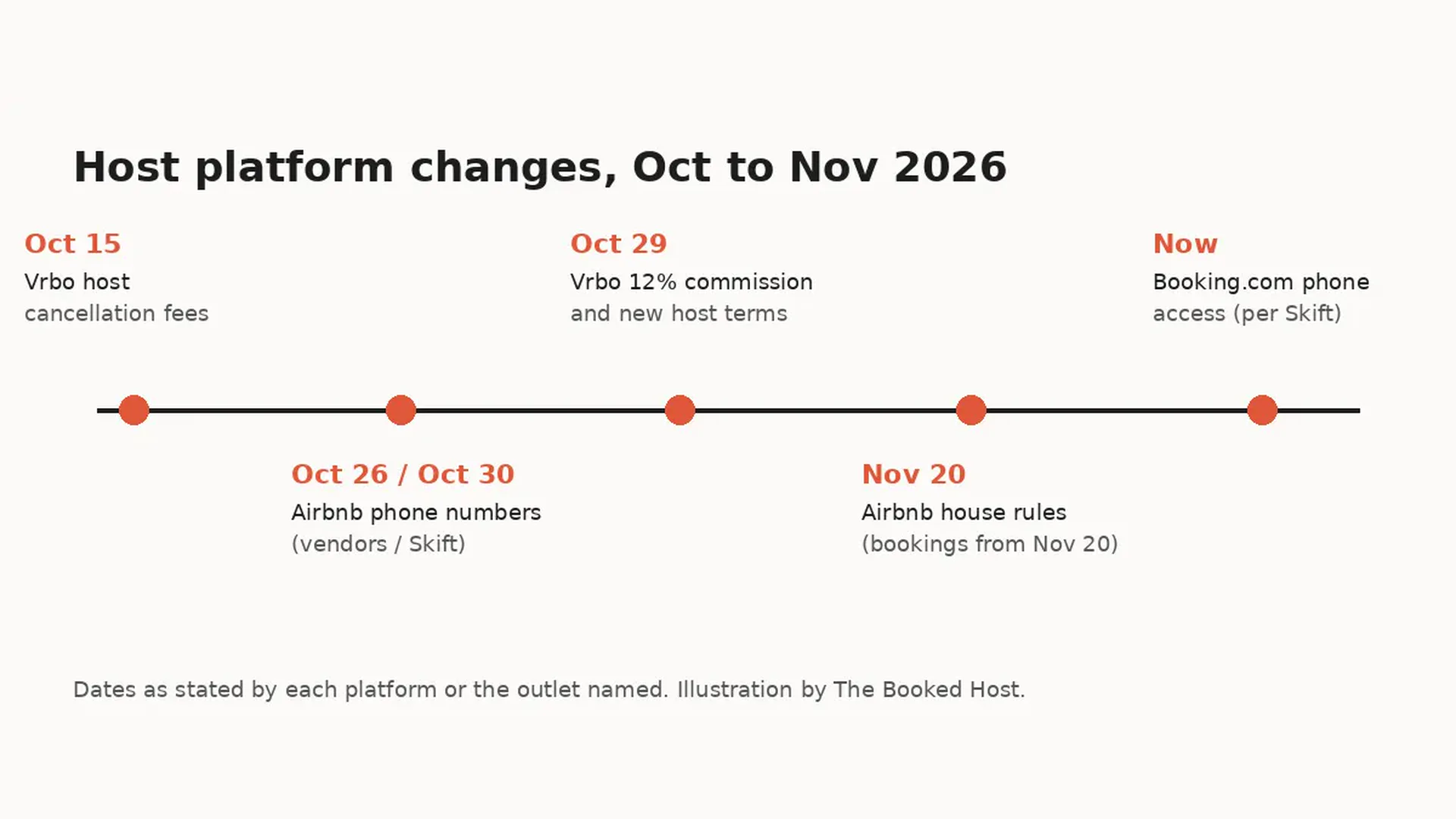
Airbnb, Vrbo and Booking.com Changes for Hosts: October-November 2026
A dated checklist of what changed for hosts in October and November 2026: Vrbo's 12% commission and new terms, Vrbo cancellation fees, Airbnb's Nov 20 rules, guest phone numbers and Booking.com.
October 29, 2026
6 min